On this page
Birthday greetings are useful whenever you speak German with friends, family or colleagues. Birthday customs vary by region, household and personal preference; the examples below are possibilities, rather than rules everyone must follow.
German birthday greetings
| English | German |
|---|---|
| Happy birthday! | Herzlichen Glückwunsch zum Geburtstag! |
| All the best on your birthday! | Alles Gute zum Geburtstag! |
| Wishing you the very best on your birthday! | Ich wünsche dir nur das Beste zum Geburtstag! |
| Congratulations on your 20th / 30th birthday! (formal) | Ich gratuliere Ihnen zu Ihrem 20. / 30. Geburtstag! |
| Lots of love on your birthday! | Alles Liebe zum Geburtstag! |
| Have a lovely celebration and may you receive plenty of presents! (informal singular) | Feier schön und lass dich reich beschenken! |
| Happy belated birthday! | Herzlichen Glückwunsch nachträglich zum Geburtstag! |
Alles Gute and Alles Liebe contain capitalized nominalized adjectives. A numbered birthday uses an ordinal full stop: zum 30. Geburtstag, spoken zum dreißigsten Geburtstag.
For a friend, say Ich gratuliere dir zu deinem Geburtstag. Formal Ihnen/Ihrem are capitalized; informal dir/deinem are normally lowercase. To thank someone, use Vielen Dank für die Glückwünsche! — Thank you for the birthday wishes!
When to congratulate someone
A common convention is to wish someone a happy birthday on the day itself or afterwards. Some people consider advance birthday wishes unlucky. Waiting until the actual day is a considerate default, but this superstition does not represent everyone’s beliefs.
You can send a card or parcel ahead of time and label it Bitte erst am Geburtstag öffnen. — Please open only on your birthday. Celebration dates depend on practical arrangements; it is misleading to claim that every German party must be on the birthday or that an earlier celebration is forbidden.
Cake, invitations and paying
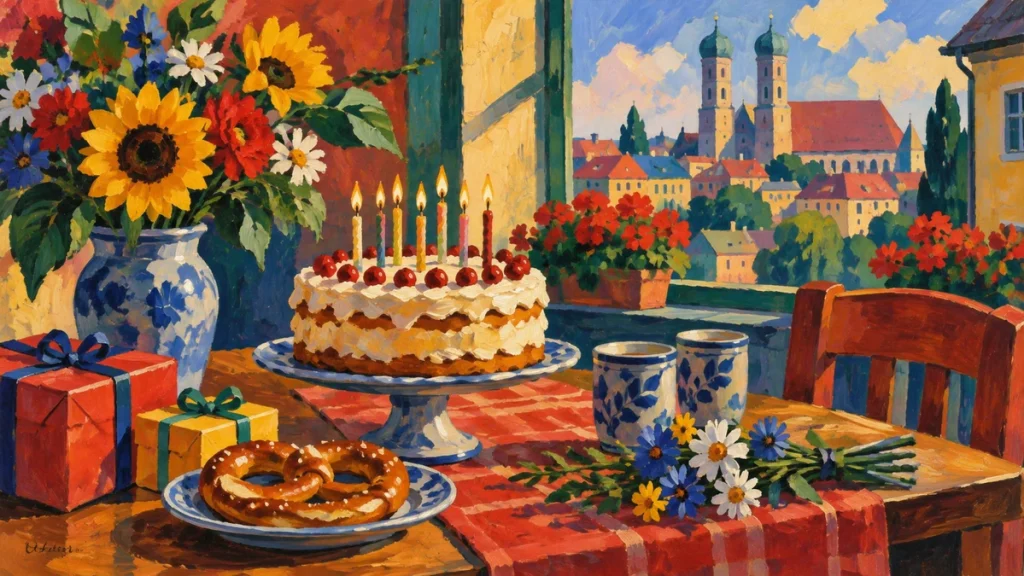
At some German workplaces, the birthday person brings cake or another treat to share. Einen ausgeben means treating others to something, such as a round of drinks; it does not refer only to buying a cake.
Expectations differ between workplaces and groups of friends. Ask what people normally do rather than assuming that someone must provide food or pay for a party. For a restaurant gathering, the invitation should make clear whether the host is treating everyone or guests pay for themselves.

Birthday cake is one familiar option, but people can choose a different treat or a different way to celebrate.
A regional example: a 30th birthday in Bremen
Bremen’s tourism office describes a local custom called Domtreppenfegen: friends may arrange for an unmarried person turning 30 to sweep the cathedral steps. A related tradition is Klinkenputzen, cleaning door handles. These are regional birthday rituals, not chores every single person in Germany is expected to do.
Traditional versions assign different tasks by gender and may involve costumes or a kiss that ends the task. What friends actually arrange varies. Read about the local history in Bremen’s guide to stair sweeping and door-handle cleaning.
Milestone birthday pranks and decorations also vary locally. Flour, eggs, drinking games or teasing about marriage should not be presented as inevitable national birthday customs. A useful question is Wie möchtest du deinen Geburtstag feiern? — How would you like to celebrate your birthday?
Children’s birthdays
Families may celebrate with a cake, games, presents and songs. A Geburtstagskranz is a birthday wreath or candle holder; some families use one instead of, or alongside, candles on a cake. Its design and number of candle positions vary.

You may hear Zum Geburtstag viel Glück or other birthday songs. The Goethe-Institut’s birthday learning materials introduce related vocabulary and songs.
A birthday does not automatically mean children have no schoolwork or household responsibilities. Each family’s celebration is different.
Useful birthday vocabulary
| German | English |
|---|---|
| der Geburtstag | birthday |
| das Geburtstagskind | birthday person (an adult too) |
| das Geschenk | present |
| die Kerze | candle |
| die Einladung | invitation |
| die Glückwünsche | congratulations / good wishes |
| feiern | to celebrate |
To write a simple birthday message: Alles Gute zum Geburtstag! Ich wünsche dir einen schönen Tag. — Happy birthday! I wish you a lovely day. In formal address: Ich wünsche Ihnen einen schönen Tag.